Drive-Time Is Prime Time: The Small-Town Case for Buying Back the Airwaves

Photo: Gage Skidmore, CC BY-SA 3.0, via Wikimedia Commons
Every morning at 7:15, Doreen Kowalski flips on the coffee roaster in her shop outside Cedar Rapids and waits for the spot she recorded two years ago to come on the radio again. It's forty seconds long. She wrote it herself. It ends with a jingle her nephew hums in the shower.
She's not on TikTok. She doesn't run A/B tests. And yet her little roastery sold out of its holiday blend three weeks early this year.
Ask her why, and she'll point at the dashboard of any car idling in her parking lot. "People aren't scrolling when they're driving," she says. "They're listening."
She's onto something.
The Auction Got Too Expensive
If you've tried to buy attention online lately, you know the story. Cost-per-click keeps creeping up. Every small hardware store, dentist, and dog groomer in America is bidding against national brands with bottomless budgets for the same eyeballs. The result: smaller businesses pay more to reach fewer people who trust them less.
Meanwhile, radio — the medium everyone declared dead sometime around 2012 — quietly kept doing what it's always done. AM/FM still reaches roughly 82% of American adults every week, according to Nielsen. Not month. Week. And a thirty-second drive-time spot in a mid-sized market often costs less than a single day of boosted social posts.
That math is why hardware store owners in Ohio, florists in Kansas, and yes, coffee roasters in Iowa are buying airtime again. Radio never got cheaper. Everything else got pricier.
Why Repetition Still Works
There's a reason you can still sing a jingle for a business that closed a decade ago. Radio's superpower is frequency — the same spot, heard five, ten, twenty times, until the name lives in your head rent-free.
Digital advertising optimizes for the click. Radio optimizes for the memory. Those are different games with different rules, and when a potential customer finally needs what you sell — a furnace repair in January, a wedding florist in May — memory is what gets the call.
One Toledo hardware store owner we spoke with put it bluntly: "My Facebook ads got me likes. My radio spots got me people standing at the counter saying, 'I heard you on the way to work.'"
The Catch: Radio Can't Show Your Face
Here's the honest limitation. Radio sells a name and a feeling. It can't show your craftsmanship, your crew, or the look on a customer's face when the job's done right.
That's not a reason to skip radio. It's a reason to pair it.
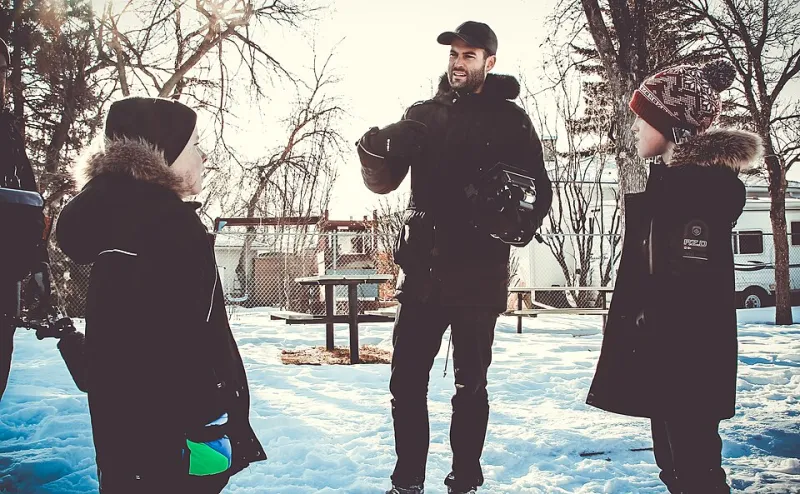
The smartest small businesses we see running radio right now treat it as one half of a two-channel story. The spot plants the name. The proof lives online — and the best proof is documentary-style video: real customers, real jobs, real locations, shot simply and honestly.
Think of it this way. The radio spot is the handshake. The video is the conversation that follows.
A Two-Channel Playbook
If you're priced out of digital auctions and curious about the dial, here's how to make one story earn its keep twice.
1. Find the story first, not the spot. Before you book airtime, figure out what you actually want people to remember. Not a list of services — a single idea. "Family-owned since 1987." "We fix it the first time." One sentence. Everything else hangs off it.
2. Write for the ear, not the eye. Radio copy has one job: sound natural when read aloud. Read your script out loud. If you stumble, rewrite it. Local radio stations will often produce the spot for free or cheap if you buy a schedule — take them up on it, but insist on using a voice that sounds like your town, not a national announcer.
3. Shoot the documentary version. Take a day and film the real thing: a customer interaction, a job in progress, your team at work. No scripts, no actors. Thirty to ninety seconds, posted where people land after they hear your name and search for you. This is the video that answers the question the radio spot raised.
4. Make the name match everywhere. If the spot says "Kowalski's Roastery," your website, your storefront, and your video titles better say it too, exactly. Radio memory decays fast when the search results don't confirm it.
5. Buy frequency, not reach. A spot heard ten times by the same commuters beats a spot heard once by ten thousand strangers. Talk to your local station about drive-time packages — mornings and evenings, when people are captive in traffic and actually paying attention.
6. Track it the low-tech way. Ask every new customer how they heard about you. Offer a radio-only promo code. It's not fancy, but it tells you more than most dashboards will.
The Bigger Lesson
The radio revival isn't really about radio. It's about what happens when a small business stops renting attention from platforms that keep raising the rent, and starts owning a memory in its own community.
A jingle in the checkout line, a voice on the morning commute, a video that shows the real work — these aren't competing channels. They're the same story, told where people actually are.
Doreen's nephew still hums her jingle in the shower. That's an impression no auction can sell you.